
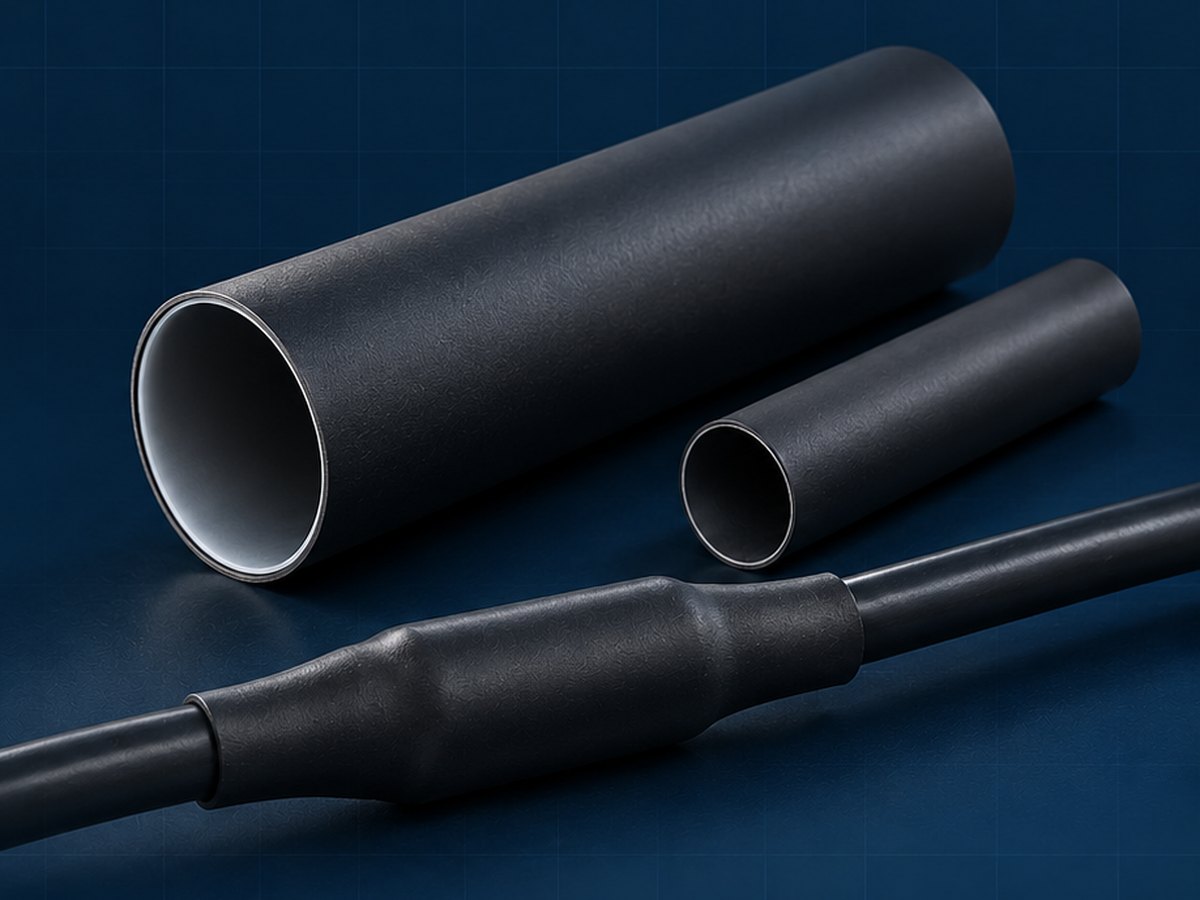
Heat shrink tubing is a protective tube that shrinks in diameter when heated in a controlled way, settling around a cable, terminal or connection. It is used for electrical insulation, mechanical protection and cable identification. Adhesive-lined types can also provide protection against moisture with the right product selection and installation. In Turkish it is called ısıyla daralan makaron.
Knowing the cable diameter alone may not be enough to choose the right tubing. The largest diameter the tubing must pass over, the smallest diameter it must settle on, the operating temperature and the sealing requirement should be evaluated together. This makes it possible to determine the right size, material and shrink ratio for the connection.
What does heat shrink tubing do?
Cable tubing takes on different roles depending on the requirements of the connection:
- Electrical insulation: It forms an insulating layer around conductive connection points.
- Mechanical protection: In suitable products, it provides protection against friction and abrasion.
- Strain relief: By supporting the transition around the connection, it can help distribute mechanical stress.
- Identification: Colour or printing makes it easier to tell cables apart.
- Environmental protection: In suitable adhesive-lined products, it limits moisture from reaching the connection.
Heat shrink tubing can be used in panel building, cable harnesses, automotive electronics, industrial equipment and defence applications. However, not every tube is suitable for all of these roles.
For example, insulating a terminal inside a device and protecting a cable splice that operates outdoors may require different products. In addition, tubing does not fix a faulty crimp or solder joint; it provides protection around a correctly made connection.
How does tubing shrink when heated?
Heat shrink tubing is produced in an expanded state. When it reaches the right temperature, it returns towards its smaller original geometry. In common cross-linked products, this behaviour is related to the shape memory of the polymer structure.
During shrinking, the inner diameter decreases, the wall thickness increases and the length of the product may change. Once the tubing settles onto the cable, its shrinking is physically restricted.
For this reason, the fully recovered inner diameter in the technical documentation is not the same as the final diameter on the cable. For example, a tube that can shrink to a 4 mm inner diameter when free does not compress an 8 mm outer diameter cable down to 4 mm; it settles around the cable.
What are the types of heat shrink tubing?
Tubing is classified by wall structure, wall thickness, material and shrink ratio. These properties should be evaluated together. A single product can be thin-wall, polyolefin-based, non-adhesive and have a 2:1 shrink ratio at the same time.
Non-adhesive vs adhesive-lined tubing
| Property | Non-adhesive tubing | Adhesive-lined tubing |
|---|---|---|
| Structure | Single-wall protective tube | Outer tube and inner adhesive layer |
| Main use | Insulation, identification and mechanical protection | In addition to insulation and protection, forming a barrier against moisture |
| Application example | Terminal inside a device or a cable harness | Cable splice and connector-to-cable transition |
| Key point in selection | Size, flexibility and environmental resistance | In addition, compatibility of the adhesive with the surface and temperature |
In TE Connectivity’s suitable adhesive-lined dual-wall tubing, the inner adhesive flows when heat is applied and helps provide environmental sealing on suitable surfaces; the level of sealing depends on the product and installation conditions. TE Connectivity dual-wall tubing
Thin, medium and heavy-wall tubing
Thin-wall tubing can be considered for connections where low bulk and flexibility are important. Medium and heavy-wall products can be used for greater mechanical protection or different insulation requirements.
Thicker tubing is not better in every application. The extra thickness can affect the flexibility of the cable and the space the connection takes up. It should also be checked under which recovery condition the wall thickness in the technical documentation was measured.
Why does the tubing material matter?
Polyolefin is a common choice for general insulation and cable protection applications. Suitable elastomer products can be considered for systems exposed to fuel, oil or hydraulic fluids, and certain fluoropolymer products for high temperatures or special chemical conditions.
The material name alone is not enough. The temperature range, fluid resistance, UV performance and flame behaviour should be verified in the technical documentation of the selected product.
What do 2:1, 3:1 and 4:1 shrink ratios mean?
The shrink ratio expresses the nominal relationship between the expanded inner diameter of the tubing and its fully recovered inner diameter when free.
| Shrink ratio | Simplified diameter example | Where it can be considered |
|---|---|---|
| 2:1 | From 12 mm to about 6 mm | Connections with a limited difference in diameter |
| 3:1 | From 12 mm to about 4 mm | Passing over a wider terminal or splice |
| 4:1 | From 16 mm to about 4 mm | A marked difference in diameter between connector and cable |
These examples are for explaining the ratio; the product’s published dimension table should be used as the purchasing size.
A high shrink ratio is not a quality grade. Its real advantage is that tubing passed over a wide part can settle onto a narrower area. Rather than choosing a high ratio that the geometry does not require, the right size and product family should be determined.
How to choose the tubing diameter?
Choosing the tubing diameter requires two measurements: the largest outer diameter it must pass over and the smallest outer diameter it must settle on once shrunk.
The first value determines installation, the second determines fit. Technical documentation contains two key values to compare these with:
| Technical term | Meaning |
|---|---|
| Expanded ID / Supplied ID | The inner diameter of the tubing as supplied |
| Recovered ID | The inner diameter after full recovery when free |
The published minimum expanded inner diameter should be sufficiently larger than the part to be passed over, and the maximum fully recovered inner diameter should be smaller than the area it must settle on. In addition, the manufacturer’s recommended application range should be followed.
TE Connectivity states that the published dimensional limits, rather than the measured diameter of a sample, should be used in selection, and that the tubing should not be forcibly stretched during installation. TE Connectivity tubing size selection guide
Do not confuse cable cross-section with outer diameter
A 2.5 mm² cable refers to the conductor cross-section, not the outer diameter of the cable. Cables with the same conductor cross-section can have different outer diameters because of their insulation material and thickness.
So the question “what size tubing does a 2.5 mm² cable need?” cannot be answered from the cross-section alone. The outer diameter including insulation should be measured or taken from the cable documentation.
Example: 8 mm cable and 14 mm connector
Say the outer diameter of the cable is 8 mm, and the widest part of the connector the tubing must pass over is 14 mm.
The selected product must first pass comfortably over the connector and then be able to settle around the cable. A selection based only on the 8 mm cable may fall short during installation.
In this case, a product with a higher shrink ratio may be a candidate. However, the decision should be verified against the actual dimension table, installation clearance, adhesive requirement and the manufacturer’s recommended application range.
Is adhesive-lined tubing waterproof?
Adhesive-lined tubing can provide protection against moisture under suitable conditions. However, being adhesive-lined does not by itself guarantee IP67, IP68 or continuous underwater use.
The result depends on the surface material, cleanliness, connection geometry and correct flow of the adhesive. In splices with multiple wires, the gaps between the wires should also be considered.
RAYCHEM ATUM offers adhesive-lined dual-wall product options. TE Connectivity’s portfolio includes ATUM 3:1 and 4:1 variants. Dimensions, temperature and other performance values should be verified in the drawing and technical documentation of the selected part number. RAYCHEM ATUM technical document
Checklist for choosing the right tubing
| Criterion | Information to check |
|---|---|
| Section to protect | Cable, terminal, splice, harness or connector transition |
| Dimensions | Largest diameter to pass over and smallest diameter to settle on |
| Sealing | Moisture, splash or immersion requirement |
| Temperature | Operating range and heat resistance of parts during installation |
| Environment | UV, abrasion, oil, fuel and other chemicals |
| Mechanical properties | Flexibility, wall thickness and available space |
| Specification | Required flame test, halogen requirement and product approvals |
| Supply format | Colour, cut length, spool or piece form and quantity |
“Flame retardant” and “halogen-free” are not the same property. Stating one does not prove the other. The test and compliance requirements of the project should be checked against the full product code.
Similarly, a single approval or temperature value within a product family should not be assumed to apply to all sizes and variants.
How to apply heat shrink tubing?
The application method should be determined according to the instructions for the selected product. The general sequence is as follows:
- Prepare the surface: Remove dirt, oil and sharp edges.
- Cut to the right length: Take into account the length change in the technical documentation.
- Position: Cover the area to be protected and the required overlap areas.
- Apply controlled heat: Heat evenly all around with the equipment and method specified by the manufacturer.
- Inspect and let it cool: Check for burning, splitting or incomplete recovery; do not stress the connection before it cools.
The shrink start temperature, full recovery temperature and continuous operating temperature are different values. The setting on a heat gun also does not directly correspond to the temperature the tubing reaches.
Controlled hot air equipment can be used in electronics and cable harness applications. Whether an open flame is suitable depends on the product instructions; energy accessories designed for torch application and electronic tubing should not be treated the same way.
Identify the right tubing for your project
For a quotation or product evaluation, sharing your application details rather than asking only for a “tubing price” makes the selection easier.
Specify the largest diameter to pass over, the smallest diameter to settle on, temperature, sealing requirement, environmental conditions, cut length and quantity. If you are using an existing product, include its part number and technical documentation as well.
You can get information about the TE Connectivity brand portfolio, including RAYCHEM, and contact Navea Electronics to evaluate product and supply options for your application.
Get in touch →Frequently asked questions
What does “makaron” mean?
“Isıyla daralan makaron” is the Turkish term for heat shrink tubing. It refers to protective tubes that shrink in diameter when heated and settle around a cable or connection.
Does the tubing size refer to the cable diameter?
No. The tubing size refers to the inner diameter of the tubing itself, not the outer diameter of the cable. Products are usually defined by their expanded inner diameter before heat is applied (Expanded ID) and the fully recovered inner diameter they can reach when free after heating (Recovered ID).
When choosing the right tubing, the expanded inner diameter must be sufficiently larger than the largest part to pass over, and the fully recovered inner diameter must be smaller than the smallest cable diameter to be protected. The manufacturer’s recommended application range and the product’s dimensional tolerances should also be taken into account.
At what temperature does tubing shrink?
There is no single temperature value. It varies by material and product family. The shrink start and full recovery temperatures should be read separately from the technical documentation.
Does tubing also shrink in length?
Many products shorten in length during shrinking; some may also lengthen. The cut length should be determined taking into account the length change in the technical documentation.
Is all black tubing suitable for outdoor use?
No. Black colour alone does not prove UV or outdoor resistance. The relevant performance data of the product should be checked.
Can tubing be used instead of electrical tape?
Tubing of the right size and properties can be used for insulation and protection in many connections. However, it should not be considered a direct alternative without evaluating installation access, voltage requirement, environmental conditions and maintenance needs.