
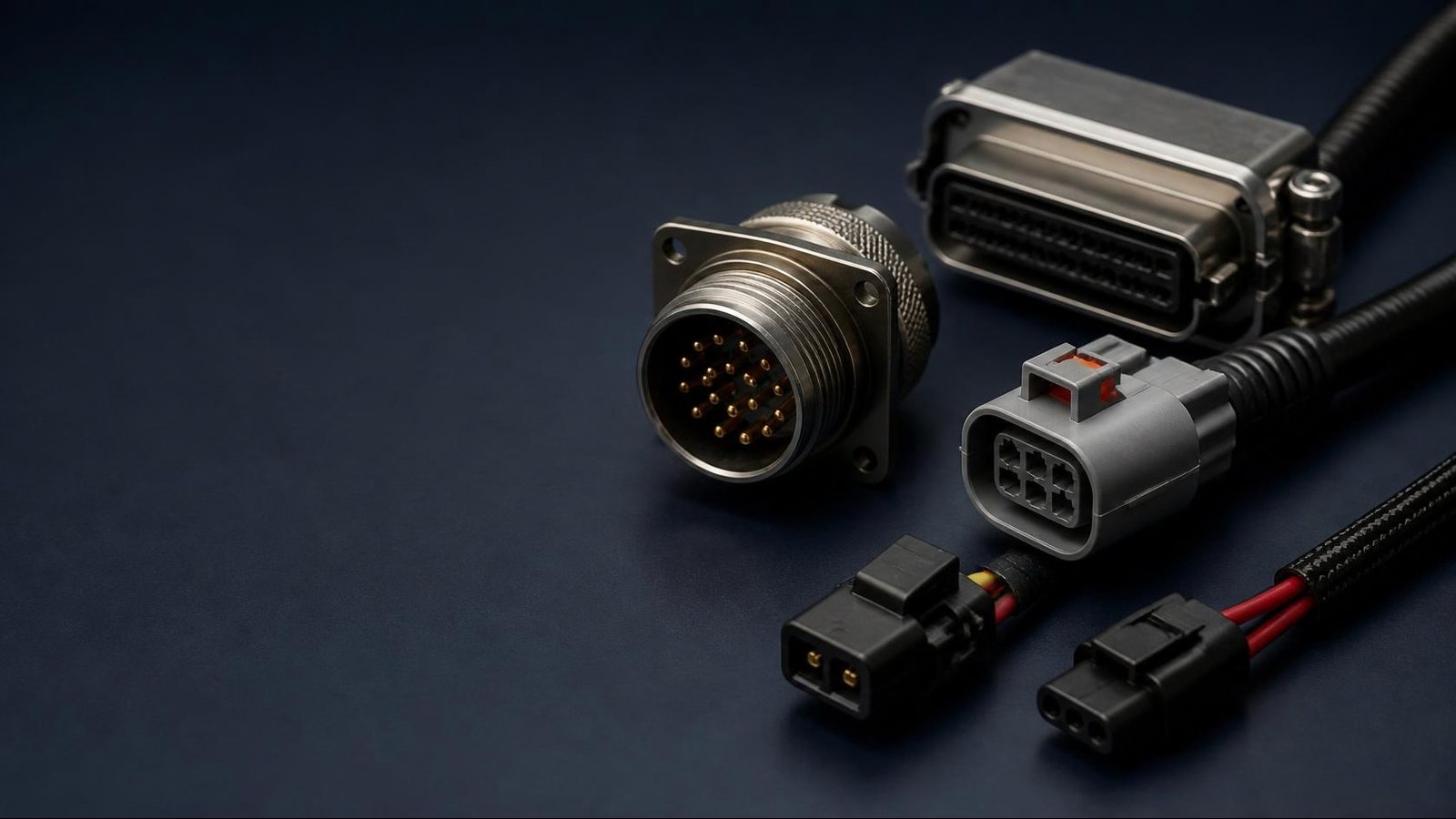
A connector is an electromechanical component that joins electrical circuits, cables or electronic components to transmit power, signal or data. When chosen correctly, it provides a reliable connection and makes assembly, maintenance and part replacement easier. Its applications range from circuit boards to industrial automation and from heavy-duty vehicles to defense systems.
Every application has different connection needs. A signal connection on a control board and a connection in the engine compartment of a construction machine do not operate under the same conditions. That is why choosing the right connector requires evaluating environmental conditions, mechanical strength and the assembly method, in addition to current, voltage and contact count.
What does a connector do?
The basic function of a connector is to create an electrical connection between two points. This connection can power a device, carry a sensor signal to a control unit or enable data transfer between systems.
Detachable connector systems also simplify production and maintenance:
- Assembly: Cable harnesses and subsystems can be prepared separately and joined at the final stage.
- Maintenance: In properly designed systems, faulty components can be replaced without cutting cables.
- Modularity: Using different modules on the same platform becomes easier.
- Connection layout: Contact arrangement and mechanical keying help reduce the risk of incorrect mating.
For example, connecting a sensor on a production line with a connector can avoid rewiring the entire installation when the sensor is replaced. For this, the connector must suit not only the electrical requirements but also the maintenance frequency and the operating environment.
The main parts of a connector
The structure of a connector varies with the product family and its intended use. The main components are:
| Component | Function |
|---|---|
| Contact | The metal element that carries current or signal. |
| Insulating insert | Holds the contacts in a defined arrangement and insulates them from each other. |
| Housing | Provides mechanical support and protects the internal components. |
| Seal | Limits the ingress of water and dust in sealed designs. |
| Locking mechanism | Helps prevent mated parts from separating unintentionally. |
Not every product has all of these parts. A board connector inside a device and a sealed connection operating outdoors are built differently.
The difference between male, female, pin and socket
The terms male and female usually describe how the contacts mate. A pin contact is the conductive element that enters the mating part. A socket contact is the element that receives the pin.
The terms plug and receptacle in catalogs describe the mating housing forms; they do not necessarily mean male and female contacts in every product family. Therefore, instead of ordering with only the phrase “male connector”, the housing type, contact type and mating part number should be checked together.
What are the types of connectors?
Connector types are classified by different criteria such as housing shape, electrical function, connection architecture and environmental properties. These properties are not alternatives to each other. The same product can be rectangular, wire-to-wire, crimp-contact and sealed.
| Classification | Examples | What it defines |
|---|---|---|
| Housing shape | Circular, rectangular, D-shaped | Mechanical interface |
| Electrical function | Power, signal, data, RF, hybrid | The nature of the power or signal transmitted |
| Connection architecture | Wire-to-wire, wire-to-board, board-to-board | The two parts being connected |
| Mounting style | Cable, panel or board mounted | Physical placement |
| Termination | Crimp, solder, IDC, screw, spring | How the conductor is connected |
| Environmental properties | Sealed, hermetic, a specific IP rating | Suitability for ambient conditions |
Circular and rectangular connectors
Circular connectors have a round mating interface. Depending on the product family, they can be used with threaded, bayonet or other locking mechanisms. Rectangular connectors offer different contact arrangements and packaging options.
Both shapes can be used in industrial equipment, vehicles and electronic systems. Housing shape alone does not determine durability; a circular connector cannot automatically be assumed to be waterproof or compliant with a military standard.
Power, signal, data and RF connectors
For power connectors, current-carrying capacity and temperature rise come first. For signal connectors, contact stability matters; for data connectors, the supported interface and signal integrity are important. RF connectors are evaluated by properties such as operating frequency and impedance.
Hybrid designs can combine different functions, such as power and signal, in the same housing. However, the electrical requirement of each contact group should be checked separately.
Connection and termination methods
Wire-to-wire connectors join two cable harnesses, wire-to-board connectors join a cable to a printed circuit board, and board-to-board connectors join two boards.
Termination describes how the conductor is incorporated into the connection. In crimping, the contact is compressed onto the conductor in a controlled way with the appropriate tool. In a soldered connection, the joint is made with solder. Screw and spring systems hold the conductor by mechanical pressure.
When making a choice, production equipment, assembly time and maintenance needs should be considered alongside electrical performance.
Waterproof connectors: what do IP67 and IP68 mean?
“Waterproof connector” is a common expression for products that provide protection against water ingress under certain conditions. The extent of protection should be evaluated together with the IP rating and the product’s test conditions.
The first digit of the IP code indicates protection against solid objects and dust, and the second digit indicates protection against water ingress.
| Rating | Basic meaning |
|---|---|
| IP67 | Complete protection against dust and resistance to the temporary immersion conditions defined in the standard |
| IP68 | Complete protection against dust and resistance to more demanding immersion conditions specified by the manufacturer |
IP68 does not mean use underwater at any depth and for an unlimited time. The permitted depth and duration should be read from the product documentation. Resistance to immersion and suitability for high-pressure hot water washing are also separate properties.
For many connectors, the IP rating applies when the parts are fully mated and correctly assembled. Some products require additional accessories. TE Connectivity’s descriptions of sealed connectors define protection performance together with these conditions.
This is why the cable-to-seal fit, sealing unused cavities and full engagement of the lock are important. The protection of the connector in the unmated state should also be checked separately.
Is a military connector the same as a circular connector?
Circular describes the housing shape; the term military connector describes the field of application or a relationship with specific military specifications. Not every circular connector is military, and not all connectors in military applications are circular.
MIL-DTL-38999 is a US military specification covering miniature, high-density, circular and environment-resistant electrical connectors. It includes different coupling, contact and sealing configurations. DLA MIL-DTL-38999 record
If a project requires compliance with this specification, the phrase “38999 type” should not be accepted as sufficient. The full part number, the specification requirements and, where necessary, the qualified product listing should be verified. NASA’s application notes also state that current QPL listings should be checked. NASA application notes
Automotive and heavy-duty vehicle connectors
The location within the vehicle changes the conditions a connection will face. A connection inside the cabin and one in the engine compartment or on the chassis do not have the same needs.
For automotive connectors, temperature, vibration, exposure to water and chemicals, contact retention and ease of maintenance are evaluated together.
TE Connectivity’s DEUTSCH DT family is one of the sealed connection solutions for industrial and commercial vehicle applications such as trucks, buses, construction machinery and agricultural equipment. It offers a rectangular thermoplastic housing, an integrated latch and a wedgelock design that supports contact alignment and retention. TE Connectivity DEUTSCH DT product information
In product families such as DT, selection is not based on contact count alone. Wire range, electrical load, mounting style and environmental conditions are also examined. For brand and product scope, you can review Navea’s TE Connectivity portfolio.
How to choose the right connector?
The right choice starts with defining the requirements of the application. The nine criteria below can be used when comparing product families.
| Criterion | What to check |
|---|---|
| 1. Application and specification | Industry, customer specification, standards and qualifications |
| 2. Electrical load | Current per contact, operating voltage and wire cross-section |
| 3. Signal properties | Data rate, frequency, impedance and shielding needs |
| 4. Contact structure | Contact count, pin/socket type and arrangement |
| 5. Environmental conditions | Temperature, IP rating, humidity, chemicals and corrosion |
| 6. Mechanical strength | Vibration, shock, locking and cable support |
| 7. Service needs | Mating cycles, keying and contact replacement |
| 8. Assembly | Placement, termination method, plating compatibility and tooling |
| 9. Size and supply | Mounting space, accessories, availability and total cost |
Read current and voltage values correctly
The current value in a catalog does not mean the same capacity can be used in every application. The permissible current may depend on conditions such as wire cross-section, ambient temperature and the number of contacts loaded at the same time. The manufacturer’s test conditions and, if available, current derating curves should be examined.
Operating voltage and dielectric withstanding test voltage are also different. A high test voltage does not show that the product can be used continuously at that voltage. The usage limits in the technical documentation should be taken as the basis.
Which properties should you check in the datasheet?
In the product documentation, rated current and voltage, wire range, operating temperature, IP conditions, mating durability and contact plating should be checked. Compatible mating parts and assembly instructions are also part of the selection.
For example, the phrase “6-pin connector protected against water” is enough as a starting point; but to specify a product, the current per contact, wire cross-section, operating temperature and the type of water exposure must also be known.
The appropriate contact, seal, blanking plug and crimp tool should be selected together. Parts that look similar should not be assumed to be compatible within the same connection system.
Identify the right connector for your project
Preparing the application area, current and voltage, contact count, wire cross-section, connection architecture and environmental conditions before the technical evaluation makes the selection process easier.
If you are looking for an alternative to an existing product, sharing the part number and its technical documentation also helps the comparison. To evaluate your project requirements and suitable connector options, you can contact Navea Electronics.
Get in touch →Frequently asked questions
What does “konnektör” mean?
“Konnektör” is the Turkish word for connector, a connecting component. In electrical and electronic engineering, it refers to connectors used to transmit power, signal or data.
What is the difference between a connector and a socket?
Connector is the general name for the connecting component. Socket, depending on the context, describes a female contact or the receptacle into which a part is inserted. The correct meaning should be determined by the terminology of the product family.
Can connectors with the same pin count be used interchangeably?
Pin count alone is not enough. The housing, contact arrangement, mechanical keying, electrical ratings and environmental properties must also be compatible.
Can a connector be mated and unmated under load?
Only products whose suitability for this use is explicitly stated should be mated and unmated under load, within the defined limits. Being detachable does not mean a connector is suitable for disconnection under load.
Can connector contacts be replaced?
In some products, contacts can be removed and replaced with the appropriate tools; in others they are fixed. The product’s service and assembly instructions should be checked before any work.